
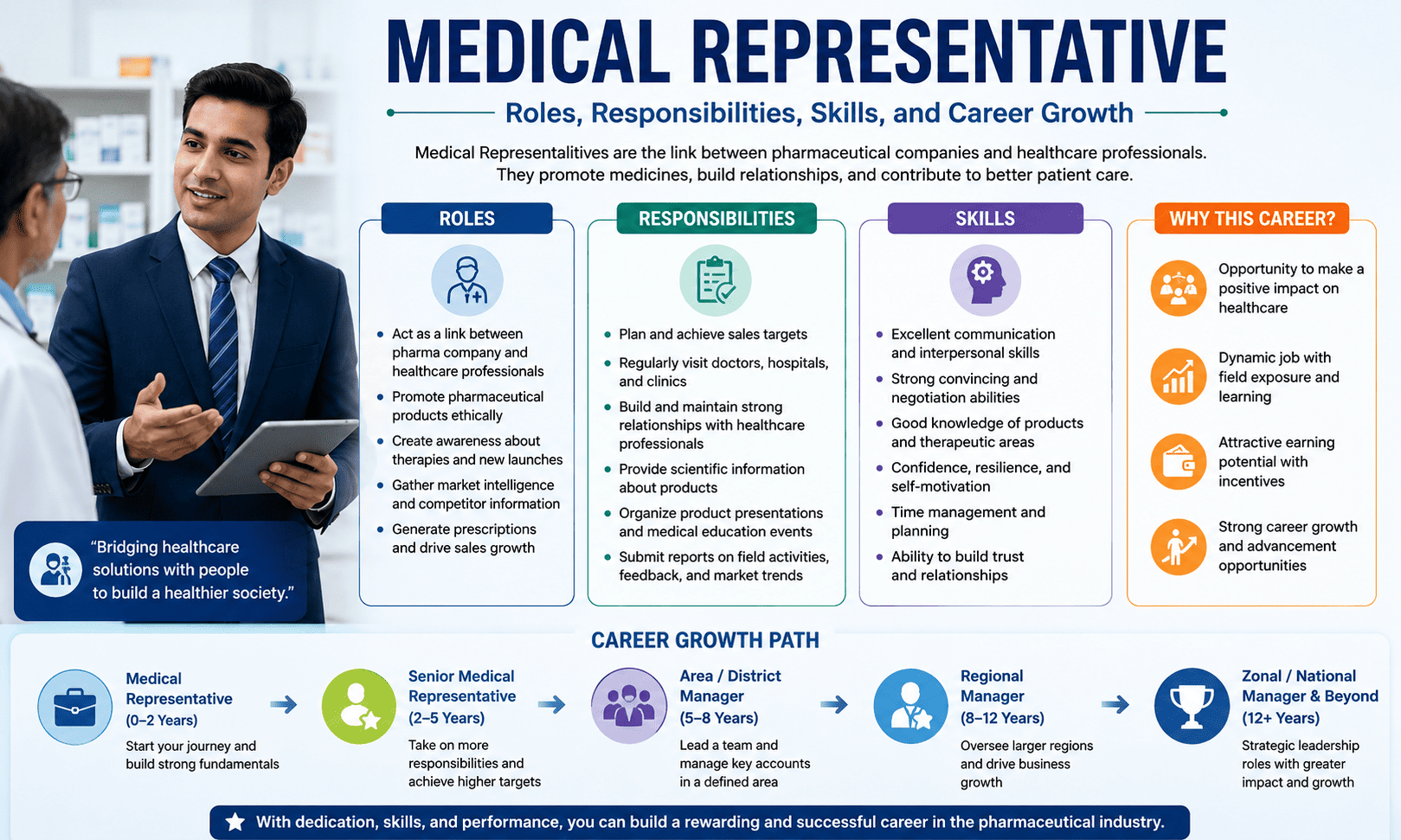
A Medical Representative (MR) is a healthcare sales professional who promotes pharmaceutical products, medicines, medical devices, and healthcare solutions to doctors, hospitals, clinics, and pharmacists. Medical Representatives play a crucial role in connecting pharmaceutical companies with healthcare professionals and ensuring that doctors are informed about the latest medicines and treatment options.
MR Full Form in Medical: Medical Representative – Roles, Responsibilities, Skills, and Career Growth
The pharmaceutical industry is one of the fastest-growing sectors globally, creating numerous career opportunities for professionals. One of the most important positions in this industry is that of a Medical Representative (MR). Medical Representatives act as a bridge between pharmaceutical companies and healthcare professionals by promoting medicines and providing product-related information. Pharma Lead is a leading online B2B pharma portal connecting pharma entrepreneurs with ISO, WHO-GMP & GMP-certified.
They help doctors understand the benefits, dosage, indications, and safety profiles of pharmaceutical products, ultimately contributing to better patient care.
What is a Medical Representative?
A Medical Representative (MR) is a sales and marketing professional responsible for promoting pharmaceutical products to healthcare providers such as:
- Doctors
- Physicians
- Surgeons
- Pharmacists
- Hospitals
- Clinics
- Healthcare institutions
Their primary objective is to increase awareness and prescription generation for the company’s products.
Key Roles and Responsibilities of a Medical Representative
1. Product Promotion
Medical Representatives introduce pharmaceutical products to healthcare professionals and explain their benefits, usage, dosage, and effectiveness.
2. Doctor Visits
Regular visits to doctors are a core responsibility. During these visits, MRs discuss:
- New product launches
- Clinical benefits
- Product comparisons
- Scientific updates
3. Building Professional Relationships
Strong relationships with doctors, pharmacists, and hospital staff help MRs establish trust and improve product acceptance.
4. Achieving Sales Targets
Every MR is assigned monthly, quarterly, and annual sales targets. Meeting these targets is a major performance indicator.
5. Conducting Product Demonstrations
Medical Representatives explain product features and benefits through presentations and demonstrations.
6. Market Research
MRs continuously monitor:
- Competitor products
- Pricing strategies
- Market trends
- Prescription patterns
7. Organizing CME Programs
They help organize:
- Continuing Medical Education (CME) programs
- Doctor meetings
- Medical conferences
- Product awareness campaigns
8. Reporting and Documentation
Medical Representatives maintain records of:
- Doctor calls
- Sales activities
- Market feedback
- Product performance
9. Product Sampling
Distribution of medicine samples to healthcare professionals is another important responsibility.
10. Customer Support
MRs address product-related queries from doctors and healthcare providers.
Daily Activities of a Medical Representative
A typical day of an MR includes:
- Planning doctor visit schedules
- Meeting healthcare professionals
- Promoting products
- Submitting daily call reports
- Collecting market intelligence
- Monitoring competitor activities
- Following up on product prescriptions
Skills Required for a Medical Representative
Communication Skills
Excellent verbal communication helps MRs explain product benefits effectively.
Product Knowledge
Comprehensive knowledge about medicines, formulations, and therapeutic areas is essential.
Sales Skills
Strong selling abilities help achieve business goals.
Relationship Management
Building long-term professional relationships increases prescription generation.
Time Management
MRs must manage multiple doctor visits and territories efficiently.
Presentation Skills
Effective presentations help convince healthcare professionals.
Negotiation Skills
Useful for dealing with distributors and institutional customers.
Problem-Solving Ability
Quickly resolving customer concerns enhances credibility.
Educational Qualifications Required
Most pharmaceutical companies prefer candidates with:
- B.Pharm
- D.Pharm
- M.Pharm
- B.Sc. (Life Sciences)
- Biotechnology
- Microbiology
- Nursing
- Other healthcare-related degrees
Some companies also hire graduates with strong sales aptitude and provide product training.
Career Growth Opportunities for Medical Representatives
The pharmaceutical industry offers excellent career progression.
Career Path
- Medical Representative (MR)
- Senior Medical Representative
- Area Sales Manager (ASM)
- Regional Sales Manager (RSM)
- Zonal Sales Manager (ZSM)
- National Sales Manager (NSM)
- Sales Director
With experience and performance, professionals can move into marketing, training, product management, and business development roles.
Advantages of Becoming a Medical Representative
Attractive Salary Packages
Pharmaceutical companies offer competitive salaries along with incentives.
Performance Bonuses
High-performing MRs receive incentives based on target achievement.
Career Advancement
Rapid promotion opportunities are available for successful candidates.
Industry Exposure
MRs gain valuable knowledge about medicines and healthcare systems.
Professional Networking
Regular interactions with healthcare professionals help build strong industry connections.
Challenges Faced by Medical Representatives
While the profession is rewarding, it also presents challenges:
- High sales targets
- Extensive traveling
- Competitive market environment
- Frequent doctor visits
- Pressure to achieve performance goals
Successful MRs overcome these challenges through dedication, product knowledge, and strong communication skills.
Importance of Medical Representatives in the Pharmaceutical Industry
Medical Representatives play a critical role in:
- Increasing product awareness
- Supporting new medicine launches
- Providing scientific information
- Gathering market feedback
- Enhancing brand visibility
- Driving pharmaceutical sales growth
They serve as the primary link between pharmaceutical companies and healthcare professionals.
Future Scope of Medical Representatives in India
The Indian pharmaceutical market continues to expand due to:
- Growing healthcare awareness
- Increasing demand for medicines
- Expansion of healthcare infrastructure
- Rise in chronic diseases
- Growth of specialty pharmaceuticals
As a result, the demand for skilled Medical Representatives remains strong across India.
Frequently Asked Questions (FAQs)
What is the full form of MR in medical?
MR stands for Medical Representative.
What does a Medical Representative do?
A Medical Representative promotes pharmaceutical products and provides product information to doctors, pharmacists, and healthcare professionals.
Is Medical Representative a good career?
Yes, it offers strong earning potential, career growth, incentives, and opportunities in the pharmaceutical industry.
What qualifications are required to become an MR?
Candidates with B.Pharm, D.Pharm, M.Pharm, B.Sc., Biotechnology, Microbiology, Nursing, and other healthcare-related degrees are commonly preferred.
What is the salary of a Medical Representative in India?
The salary varies depending on experience, company, and location. Entry-level MRs typically receive a fixed salary along with travel allowances and performance incentives.
The full form of MR in medical is Medical Representative. Medical Representatives are essential contributors to the pharmaceutical industry, helping bridge the gap between pharmaceutical companies and healthcare professionals. Their responsibilities include product promotion, doctor engagement, market research, and sales growth. With excellent career opportunities, attractive incentives, and long-term growth potential, the role of a Medical Representative remains one of the most sought-after careers in the healthcare and pharmaceutical sector.